USA Cultural and Events Email List Database
$490.00 Original price was: $490.00.$49.00Current price is: $49.00./0.00542402 0.00054240
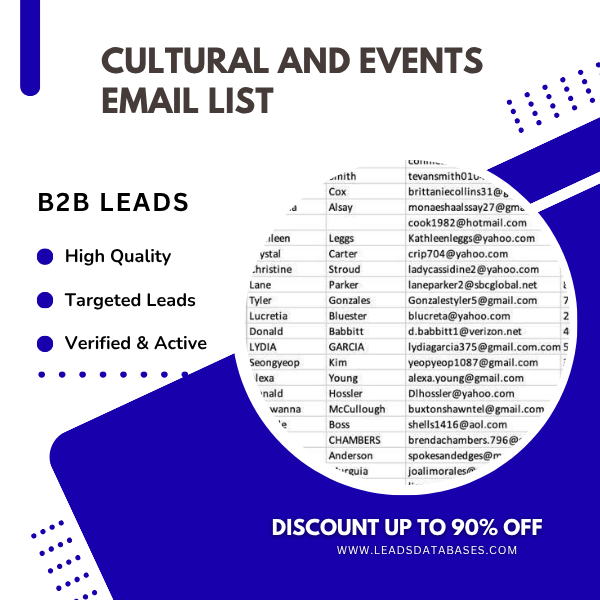
Leads Name: USA Cultural and Events Email List Database
Accuracy Rate: 95%+ Verified, Less Than 3% Bounce
Coverage: All USA States & Cities
Data Fields: Full Name, Email, Phone Number & Many More
Format: Delivered in Clean Excel (.xlsx), No Duplicates
Special Feature: Fresh & Ready-to-Use Data That Converts
Cultural and Events Email List: Connect with Museums, Festivals, Event Organizers, and Cultural Institutions
A Cultural and Events Email List helps businesses connect with organizations involved in arts, entertainment, heritage, exhibitions, festivals, conferences, and live events. Instead of spending weeks searching for contact information, companies can use a targeted business database to reach decision-makers responsible for purchasing products and services.
Whether you offer event technology, ticketing software, audiovisual equipment, exhibition displays, printing, security services, marketing solutions, catering, or consulting, reaching the right audience is essential. A relevant database allows your sales and marketing teams to focus on organizations that are more likely to benefit from your offerings.
However, not every email database delivers the same value. Outdated contact information, poor segmentation, and irrelevant records can reduce campaign performance and waste marketing budgets. Choosing a provider that focuses on organised business data, transparent information, and industry relevance can make outreach more efficient.
Why Choose Leadsdatabases.com
Finding accurate business contacts in the cultural and events industry takes time. Organisations range from local museums and nonprofit arts groups to international event management companies, convention organizers, and performing arts venues. Each has different purchasing needs and decision-makers.
Leadsdatabases.com provides business contact databases designed to help companies simplify prospecting while improving audience targeting.
Industry-Focused Business Data
Rather than relying on broad business directories, businesses can purchase databases focused on industries relevant to their products or services. A targeted Cultural and Events email database allows marketers to reach organizations operating within the arts, entertainment, heritage, tourism, and live events sectors.
Examples include:
- Museums
- Art galleries
- Cultural centers
- Heritage organizations
- Performing arts venues
- Community arts organizations
- Festival organizers
- Exhibition organizers
- Convention centers
- Event production companies
- Conference organizers
- Live entertainment venues
Better targeting often leads to more relevant conversations.
Organized Contact Information
Depending on the available records, business databases may include:
- Company name
- Business email address
- Contact name
- Job title
- Phone number
- City
- State
- Country
- Website
- Industry classification
Available fields may vary by database.
Save Time on Prospecting
Building an outreach list manually often involves researching websites, verifying contact details, and organizing spreadsheets. Purchasing a structured database allows marketing and sales teams to spend more time creating personalized campaigns instead of collecting data.
Useful for Multiple Industries
Businesses commonly purchasing a Cultural and Events mailing list include:
- Event technology providers
- CRM software companies
- Ticketing platform vendors
- Printing companies
- Promotional product suppliers
- Audio visual equipment providers
- Exhibition display manufacturers
- Catering companies
- Security service providers
- Digital marketing agencies
- Tourism businesses
- Hospitality suppliers
- Business consultants
A relevant contact database supports lead generation across many B2B industries.
What Is a Cultural and Events Email List?
A Cultural and Events email list is a business contact database containing organisations involved in planning, managing, promoting, or hosting cultural programs and public events.
These organisations may include museums, theaters, galleries, historical societies, nonprofit cultural organisations, festivals, exhibition companies, convention organisers, and event management firms.
Businesses use these databases to:
- Generate qualified B2B leads
- Introduce products and services
- Promote software solutions
- Build strategic partnerships
- Support sponsorship outreach
- Schedule sales appointments
- Conduct market research
- Expand into new geographic markets
Unlike consumer mailing lists, these databases focus on professional organisations and business decision-makers.
Organisations Commonly Included
Depending on the provider, a Cultural and Events business email database may contain contacts from:
Museums
Museums frequently purchase services related to:
- Visitor management
- Digital exhibits
- Security systems
- Audio guides
- Exhibit design
- Marketing
- Printing
Art Galleries
Commercial and nonprofit galleries often require:
- Exhibition displays
- Lighting solutions
- Marketing services
- Event planning
- Visitor engagement technology
Festival Organisers
Festival management teams regularly source:
- Event registration software
- Temporary staffing
- Promotional merchandise
- Crowd management
- Catering
- Ticketing systems
- Equipment rentals
Convention and Conference Organisers
Conference planners often work with vendors offering:
- Registration platforms
- Event mobile apps
- Name badge printing
- AV production
- Live streaming
- Venue technology
Performing Arts Organisations
Theaters, orchestras, opera companies, dance organisations, and cultural performance venues frequently purchase services supporting audience engagement and event operations.
Benefits of Using a Cultural and Events Email Database
A targeted business database offers advantages beyond simply providing contact information.
Better Audience Targeting
Instead of emailing thousands of unrelated businesses, marketers can focus on organisations already operating within the cultural and events sector.
Relevant targeting helps create more personalised campaigns.
Higher Marketing Efficiency
Sales teams spend less time researching contacts and more time speaking with potential customers.
Marketing teams can also create campaigns tailored to different organisation types.
Improved Campaign Personalisation
A museum director has different priorities than a festival organiser.
Segmentation allows businesses to customise messaging for:
- Museums
- Performing arts venues
- Event planners
- Heritage organisations
- Exhibition companies
- Convention centers
- Community cultural organisations
Personalised outreach generally performs better than generic messaging.
Supports Multiple Marketing Channels
A Cultural and Events contact database can support:
- Email marketing
- Cold outreach
- Appointment setting
- CRM enrichment
- LinkedIn prospecting
- Partnership campaigns
- Sales development
- Business networking
Many organisations combine several channels rather than relying on email alone.
Geographic Expansion
Businesses entering new cities, states, or countries can identify organisations operating within their target markets without building contact lists from scratch.
This supports regional marketing campaigns while saving research time.
Best Practices for Marketing to Cultural and Event Organisations
Purchasing an email database is only one part of a successful outreach strategy.
Research Your Audience
Different organisations solve different problems.
For example:
- Museums focus on visitor engagement.
- Festivals prioritise attendance and logistics.
- Convention centers emphasise event operations.
- Cultural nonprofits often focus on fundraising and community outreach.
Understanding these differences improves communication.
Personalise Every Email
Avoid sending identical emails to every recipient.
Reference the recipient’s organisation, explain why your solution is relevant, and provide a clear benefit.
Personalszation builds credibility.
Focus on Business Value
Instead of listing product features, explain outcomes.
Examples include:
- Streamlining registration
- Improving visitor experiences
- Simplifying ticket sales
- Reducing administrative work
- Supporting event operations
- Increasing operational efficiency
Decision-makers often respond better to solutions than technical specifications.
Keep Messages Short
Busy professionals appreciate concise communication.
An effective email usually includes:
- A clear subject line
- Short introduction
- Relevant value proposition
- One call to action
Simple emails are easier to read and easier to answer.
Follow Responsible Email Marketing Practices
Businesses should comply with applicable privacy and email marketing regulations in the countries where they operate. Respecting recipient preferences and maintaining accurate contact records supports long-term business relationships and protects your brand reputation.
How to Choose the Right Cultural and Events Email List
Not every business database offers the same level of relevance or usability. Before purchasing a Cultural and Events email list, evaluate whether the data matches your sales goals, target audience, and geographic focus.
Define Your Target Market
Start by identifying the organisations you want to reach. For example, a company selling event registration software may focus on conference organisers and event management companies, while an exhibition display supplier may target museums, galleries, and trade show organisers.
Common target segments include:
- Museums and heritage sites
- Art galleries
- Cultural centers
- Festival organisers
- Concert promoters
- Performing arts organisations
- Convention and exhibition centers
- Event production companies
- Nonprofit arts organisations
- Tourism and destination marketing organisations
A clearly defined audience improves campaign relevance and helps your team prioritise the right prospects.
Look for Useful Data Fields
A business contact database becomes more valuable when it includes information that supports segmentation and personalised outreach.
Depending on availability, look for fields such as:
- Business name
- Contact name
- Job title
- Business email address
- Phone number
- Website
- City
- State or province
- Country
- Industry category
These details can help your sales team personalise communication instead of sending generic messages.
Consider Geographic Coverage
Some businesses market locally, while others serve customers nationwide or internationally.
Choose a database that aligns with your market, whether you are targeting:
- Local cultural organisations
- Regional event planners
- National museum networks
- International exhibition companies
- Global conference organisers
Geographic filtering also helps businesses create location-specific marketing campaigns.
Prioritise Data Organisation
Well-organised data saves time during campaign setup.
A structured Cultural and Events email database should allow businesses to sort contacts by industry, location, organisation type, or other relevant categories. Better organisation supports cleaner CRM imports and more efficient lead management.
Industries That Commonly Market to Cultural and Event Organizations
Many B2B companies serve organisations in the arts and events sector. A targeted contact database allows these businesses to introduce relevant products and services to potential buyers.
Event Technology Providers
Technology plays an important role in modern events. Event organisers often evaluate solutions such as:
- Event management software
- Online registration platforms
- Digital ticketing systems
- Mobile event applications
- Virtual and hybrid event platforms
- Visitor analytics tools
Technology vendors frequently use targeted email outreach to introduce new solutions and schedule product demonstrations.
Printing and Signage Companies
Cultural organisations regularly require printed materials, including:
- Event programs
- Posters
- Directional signage
- Exhibition graphics
- Visitor guides
- Promotional banners
- Branded displays
A targeted business mailing list helps printing companies reach organisations planning seasonal events and exhibitions.
Audio Visual and Production Companies
Concerts, conferences, museums, and festivals depend on professional production services.
Common offerings include:
- Sound systems
- Lighting equipment
- LED displays
- Live streaming
- Video production
- Stage design
- Presentation technology
These providers often market directly to event planners and venue managers.
Hospitality and Catering Businesses
Food and hospitality services support many public events.
Potential clients include:
- Conferences
- Fundraising galas
- Community festivals
- Cultural celebrations
- Museum events
- Private exhibitions
Building relationships with organisers can create long-term business opportunities.
Marketing and Creative Agencies
Creative agencies often support organisations with:
- Digital advertising
- Social media marketing
- Branding
- Graphic design
- Public relations
- Website development
- Content marketing
Many agencies focus on organisations launching new exhibitions, festivals, or community programs.
Email Marketing Tips for Better Engagement
Having quality contact information is important, but campaign success depends on delivering relevant messages.
Write Clear Subject Lines
Your subject line influences whether recipients open your email.
Keep it concise, relevant, and focused on value rather than exaggerated claims.
Examples include:
- Solutions for Museum Visitor Engagement
- Event Registration Software for Conferences
- Exhibition Display Services for Cultural Venues
Simple subject lines often outperform overly promotional ones.
Segment Before Sending
Instead of one large campaign, create smaller campaigns based on:
- Organisation type
- Industry
- Geographic location
- Business size
- Services offered
Segmentation allows you to speak directly to each audience’s needs.
Offer Helpful Information
Decision-makers receive many promotional emails.
Provide practical value by sharing:
- Industry insights
- Product demonstrations
- Educational resources
- Case studies
- Implementation guides
- Consultation opportunities
Helpful content builds trust over time.
Include One Clear Call to Action
Avoid asking recipients to complete multiple actions.
Instead, encourage one simple next step, such as:
- Request a product demonstration
- Schedule a consultation
- Download a brochure
- Learn more about your services
- Contact your sales team
A focused call to action improves clarity.
Measure Campaign Performance
Track key performance indicators such as:
- Open rates
- Click-through rates
- Reply rates
- Qualified leads
- Sales opportunities
Reviewing campaign data helps businesses refine future outreach strategies.
Conclusion
A Cultural and Events email list provides businesses with an efficient way to reach organisations involved in museums, festivals, performing arts, exhibitions, conferences, cultural institutions, and live events. Rather than spending valuable time collecting contact information manually, companies can focus on building meaningful business relationships through targeted outreach.
Whether you provide event technology, audiovisual solutions, marketing services, exhibition products, catering, printing, security, or consulting, a well-organised Cultural and Events email database supports more focused prospecting and smarter lead generation.
Leadsdatabases.com offers business contact databases designed to help organisations connect with relevant industries more efficiently. By combining accurate audience targeting, personalised messaging, responsible email marketing practices, and valuable content, businesses can create outreach campaigns that are more relevant, more efficient, and better aligned with long-term growth.
Frequently Asked Questions
1. What is a Cultural and Events email list?
A Cultural and Events email list is a business contact database containing organisations involved in arts, entertainment, festivals, museums, exhibitions, conferences, heritage sites, and event management. Depending on the provider, records may include business names, contact names, business email addresses, phone numbers, job titles, locations, websites, and industry classifications. Companies use these databases for B2B lead generation, email marketing, partnership outreach, appointment setting, and business development.
2. Who should use a Cultural and Events email database?
A Cultural and Events email database is valuable for businesses that sell products or services to cultural institutions and event professionals. Typical users include software providers, ticketing platform companies, audiovisual suppliers, printing businesses, exhibition display manufacturers, security companies, catering providers, promotional product suppliers, digital marketing agencies, hospitality vendors, and business consultants. A targeted database helps these businesses connect with organisations that regularly purchase industry-specific solutions.
3. What types of organisations are included in a Cultural and Events mailing list?
The exact contents vary by provider, but a Cultural and Events mailing list may include museums, art galleries, cultural centers, heritage organisations, performing arts venues, theaters, concert halls, opera companies, symphony orchestras, nonprofit arts organisations, festival organisers, exhibition companies, convention centers, conference organisers, event production companies, live entertainment venues, and tourism organisations. Reviewing available industry categories before purchasing helps ensure the database matches your marketing objectives.
4. How can businesses improve results when using a Cultural and Events email list?
Successful email campaigns depend on more than accurate contact information. Businesses should segment their audience, personalise each message, write concise subject lines, explain the value of their products or services, and include a clear call to action. Following applicable email marketing and privacy regulations is equally important. Combining a quality Cultural and Events email list with relevant, helpful content generally produces better engagement than sending generic promotional emails.
5. Why consider Leadsdatabases.com for a Cultural and Events email list?
Leadsdatabases.com provides business contact databases designed to help companies reach relevant industries more efficiently. Depending on the database, businesses may be able to access organised contact information that supports lead generation, sales prospecting, CRM enrichment, and B2B email marketing. Rather than making unsupported performance claims, the focus is on offering structured business data that can help organisations identify potential customers and create more targeted marketing campaigns.