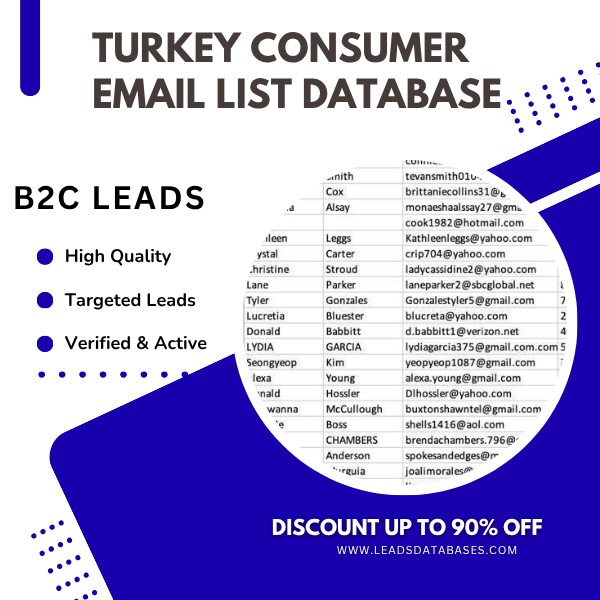
Turkey Consumer Email List Database
$1,300.00 Original price was: $1,300.00.$130.00Current price is: $130.00./0.01439026 0.00143903
Leads Name: Turkey Consumer Email List Database
Accuracy Rate: 95%+ Verified, Less Than 3% Bounce
Coverage: All Turkey States & Cities
Data Fields: Full Name, Email, Phone Number & More
Format: Delivered in Clean Excel (.xlsx), No Duplicates
Special Feature: Fresh & Ready-to-Use Data That Converts
Turkey Consumer Email List: Consumer Data, Email Marketing, and Audience Targeting
A Turkey Consumer Email List is a marketing database that may contain consumer email addresses and, depending on how the data was collected and maintained, additional information such as names, locations, or demographic attributes. Businesses use consumer marketing databases to support customer acquisition, market research, audience segmentation, and personalised email marketing, subject to applicable privacy laws and marketing regulations.
A reliable Turkey consumer email database focuses on data quality, regular maintenance, and relevant audience segmentation rather than simply offering a large volume of contacts. Businesses should ensure their marketing activities comply with Turkey’s Personal Data Protection Law (KVKK) and any other applicable privacy or electronic marketing requirements.
Why Businesses Explore Turkey Consumer Email Lists
Turkey has a large and diverse consumer market, with major commercial hubs such as Istanbul, Ankara, Izmir, Bursa, and Antalya supporting a wide range of industries, including retail, eCommerce, tourism, financial services, education, technology, and consumer goods.
For businesses expanding into the Turkish market, reaching the right audience can be more challenging than launching a product or service. Broad digital advertising campaigns may reach many people who are unlikely to become customers, increasing marketing costs without improving results.
A well-maintained Turkey Consumer Email List can support a broader digital marketing strategy by helping businesses organise outreach, segment audiences, and create more relevant communications. Combined with search engine optimisation (SEO), content marketing, customer relationship management (CRM), and marketing automation, organized consumer data can contribute to more efficient marketing workflows.
The effectiveness of any campaign depends on more than the contact database itself. Factors such as audience relevance, message quality, personalisation, data accuracy, and compliance with applicable laws all play important roles. Businesses that focus on delivering valuable content and respecting consumer preferences are generally better positioned to build long-term customer relationships.
Why Choose Leadsdatabases.com
Choosing a marketing data provider involves more than comparing the number of records available. Data quality, organisation, transparency, and ease of use are often more important than database size.
Leadsdatabases.com offers marketing data products designed to help businesses organise customer outreach and support their lead generation strategies. Rather than making unverifiable claims about campaign outcomes, the focus is on providing structured data that businesses can integrate into existing sales and marketing processes.
Organised Consumer Data
Well-organised data simplifies campaign planning and reduces the amount of manual work needed before launching email marketing initiatives. Standard file formats such as CSV or Excel can often be imported into compatible CRM systems and marketing platforms.
Audience Segmentation
Audience segmentation helps businesses create more relevant campaigns. Depending on the available dataset, contacts may be organised using information such as geographic location or other lawful attributes, making it easier to tailor messages for different audiences.
Relevant segmentation can improve customer experience by allowing businesses to send content that better matches the interests or needs of different consumer groups.
Supports Multiple Industries
A Turkey consumer marketing database may be useful for businesses operating in sectors such as:
- Retail
- eCommerce
- Consumer goods
- Travel and tourism
- Education
- Software and technology
- Financial services
- Home improvement
- Health and wellness
- Professional services
Each industry has different marketing goals, but all benefit from understanding their audience and delivering relevant communications.
CRM Integration
Many businesses use CRM platforms and marketing automation tools to manage customer relationships. Structured marketing data can help streamline campaign planning, audience organisation, and reporting when integrated with compatible business systems.
Ongoing Data Maintenance
Consumer information changes over time. Email addresses, locations, and other details may become outdated, making regular data maintenance an important part of improving overall database quality.
Benefits of a Well-Maintained Turkey Consumer Email Database
More Relevant Audience Targeting
Effective marketing begins with understanding who your customers are. A well-maintained consumer database can help businesses organise audiences based on available information, making it easier to create campaigns that are more relevant than broad, un-targeted promotions.
Better Customer Segmentation
Segmentation allows businesses to tailor messages for different customer groups instead of sending identical emails to every contact. Common segmentation approaches include geographic location, customer interests, purchasing behavior, or other lawful data points.
Personalised campaigns often provide a better customer experience because recipients receive information that is more relevant to their needs.
Supports Omnichannel Marketing
Email marketing works best when combined with other digital marketing channels, including:
- Search engine optimisation (SEO)
- Content marketing
- Social media marketing
- Paid advertising
- Customer loyalty programs
- Marketing automation
Using multiple channels helps businesses create a more consistent customer journey.
Geographic Marketing Opportunities
Businesses often focus their marketing efforts on specific regions. Turkey’s major cities including Istanbul, Ankara, Izmir, Bursa, Antalya, Adana, Gaziantep, and Konya—each have distinct consumer markets and commercial activity. Geographic targeting allows businesses to develop campaigns that are more relevant to local audiences.
Best Practices for Responsible Email Marketing
Prioritise Valuable Content
Consumers are more likely to engage with emails that provide useful information, educational resources, product updates, or relevant offers. Consistently delivering value helps build trust and long-term customer relationships.
Personalise Where Appropriate
Personalisation goes beyond using a recipient’s name. Tailoring content to audience segments, locations, or interests can make email campaigns more relevant and engaging.
Maintain Good Data Hygiene
Regularly reviewing marketing databases to remove duplicate or inactive records helps improve data quality and campaign reporting. Clean data also supports better deliverability and more accurate performance metrics.
Measure Campaign Performance
Businesses should evaluate key performance indicators such as delivery rates, open rates, click-through rates, conversions, and unsubscribe rates to understand how campaigns perform and identify opportunities for improvement.
Respect Privacy and Applicable Laws
Responsible email marketing includes complying with applicable privacy legislation, honoring unsubscribe requests, and handling personal information appropriately. In Turkey, businesses should understand their obligations under KVKK and any other relevant legal requirements before conducting marketing activities.
How to Evaluate a Turkey Consumer Email List Before Choosing a Provider
Selecting a marketing database requires more than comparing the number of available records. Businesses should focus on data quality, transparency, compatibility, and responsible data management practices.
Data Accuracy and Maintenance
Consumer information changes over time. People may update their email addresses, relocate, or change their communication preferences. A database that is reviewed and maintained regularly is generally more useful than one that remains unchanged for long periods.
When evaluating a provider, consider asking:
- How often is the database maintained?
- Are duplicate records identified and removed?
- What file formats are available?
- What information is included with each contact?
- Is customer support available after purchase?
These questions help businesses understand whether the data is suitable for their marketing objectives.
Audience Relevance Matters More Than Volume
A database containing millions of contacts is not automatically more valuable than one with a smaller, well-targeted audience.
For example, a retailer launching a fashion campaign may benefit more from relevant consumer segments than from a large, un-targeted database. Matching the audience to the product or service often improves marketing efficiency.
File Compatibility
Most businesses use CRM software or email marketing platforms to manage campaigns.
Look for data that can be imported into commonly used systems through formats such as:
- CSV
- Microsoft Excel
- TXT (where appropriate)
This reduces preparation time and helps marketing teams organize campaigns more efficiently.
Industries That May Use Consumer Marketing Data
Consumer marketing data can support a wide variety of industries when used responsibly and in accordance with applicable laws.
eCommerce
Online retailers often use customer segmentation to promote seasonal collections, product launches, special offers, and abandoned cart campaigns.
Retail
Retail businesses can organise campaigns around local promotions, store openings, holiday sales, or customer loyalty initiatives.
Travel and Hospitality
Travel agencies, hotels, airlines, and tourism businesses frequently use email marketing to share destination guides, seasonal offers, and travel updates.
Education
Educational institutions and online learning platforms may communicate information about courses, certifications, webinars, and training opportunities to prospective learners.
Technology and Software
Software companies often use email campaigns to introduce new features, publish educational resources, invite users to webinars, and announce product updates.
Financial Services
Banks, insurance providers, and financial technology companies may use email communication to share educational content, service updates, and product information while complying with applicable regulatory requirements.
Building Better Email Marketing Campaigns
A quality database supports your marketing efforts, but campaign strategy determines long-term success.
Write Helpful Subject Lines
Clear and honest subject lines encourage engagement more effectively than exaggerated claims.
Consider these best practices:
- Keep them concise.
- Focus on the reader’s benefit.
- Avoid misleading language.
- Match the content inside the email.
Create Valuable Content
Every email should provide something worthwhile.
Examples include:
- Educational articles
- Buying guides
- Industry insights
- Product updates
- Exclusive promotions
- Helpful resources
- Seasonal recommendations
Useful content encourages readers to stay engaged over time.
Personalise Your Messaging
Consumers appreciate communication that reflects their interests.
Depending on the available information and applicable legal requirements, businesses may personalise campaigns using factors such as:
- Geographic location
- Customer interests
- Previous interactions
- Product preferences
- Language preferences
Relevant messaging often creates a better customer experience than generic mass communication.
Monitor Campaign Performance
Review campaign metrics regularly to understand what resonates with your audience.
Common performance indicators include:
- Delivery rate
- Open rate
- Click-through rate
- Conversion rate
- Bounce rate
- Unsubscribe rate
Continuous testing and improvement can help businesses refine future campaigns.
Why Data Quality Is More Important Than Database Size
Businesses sometimes focus on the number of contacts in a database, but quality is usually the more important factor.
Reliable marketing data can help teams:
- Save time during campaign planning.
- Improve audience organization.
- Reduce duplicate records.
- Support better customer segmentation.
- Integrate information with CRM systems.
- Measure campaign performance more effectively.
A well-organised Turkey Consumer Email List should support broader marketing goals rather than serve as the only source of customer acquisition. Combining email marketing with search engine optimisation (SEO), content marketing, social media, paid advertising, and customer relationship management creates a more balanced digital marketing strategy.
Conclusion
A Turkey Consumer Email List can support businesses that want to organise audience data and strengthen their digital marketing efforts. The greatest value comes from combining accurate consumer information with thoughtful audience segmentation, personalised content, CRM integration, and responsible email marketing practices.
When evaluating a marketing database, focus on factors such as data quality, maintenance, compatibility, transparency, and customer support instead of simply comparing the number of contacts. Businesses should also understand and follow applicable privacy and electronic marketing requirements, including Turkey’s Personal Data Protection Law (KVKK) where relevant.
Leadsdatabases.com provides marketing data products designed to help businesses organise customer outreach and marketing activities. As with any marketing resource, successful results depend on relevant messaging, valuable content, continuous optimisation, and responsible data use.
Frequently Asked Questions
1. What is included in a Turkey Consumer Email List?
A Turkey Consumer Email List is a marketing database that may include consumer email addresses and, depending on the dataset, information such as names, geographic locations, or other marketing-related attributes. The specific fields available vary by provider. Before using any consumer data, businesses should ensure that their marketing activities comply with applicable privacy laws, electronic marketing regulations, and industry best practices.
2. Which businesses can benefit from a Turkey Consumer Email Database?
Retailers, eCommerce businesses, travel companies, software providers, educational institutions, financial service providers, consumer brands, and professional service firms may use consumer marketing data as part of broader digital marketing strategies. The value of a database depends on how well it aligns with the intended audience, campaign objectives, and responsible data management practices.
3. How do I choose a reliable consumer marketing database?
Evaluate factors such as data maintenance, audience relevance, available segmentation, file compatibility, transparency, and customer support. Rather than focusing only on database size, look for organised, well-maintained information that supports your marketing goals. Understanding how the provider manages and updates data can help you make a more informed purchasing decision.
4. Can a Turkey Consumer Email List be integrated with CRM software?
Many providers deliver marketing databases in widely supported formats such as CSV or Excel, making them compatible with numerous CRM and email marketing platforms. Before importing data, verify your platform’s requirements and ensure your marketing activities comply with applicable privacy obligations, consent requirements, and unsubscribe procedures where required.
5. Why is audience segmentation important in email marketing?
Audience segmentation allows businesses to create more relevant communication for different customer groups instead of sending identical messages to everyone. Organising contacts by lawful attributes such as geographic location or customer interests can improve personalisation, customer engagement, and campaign relevance. When combined with valuable content and ongoing campaign analysis, segmentation contributes to a more effective long-term email marketing strategy.