Spain Consumer Email List Database
$1,200.00 Original price was: $1,200.00.$120.00Current price is: $120.00./0.01328332 0.00132833
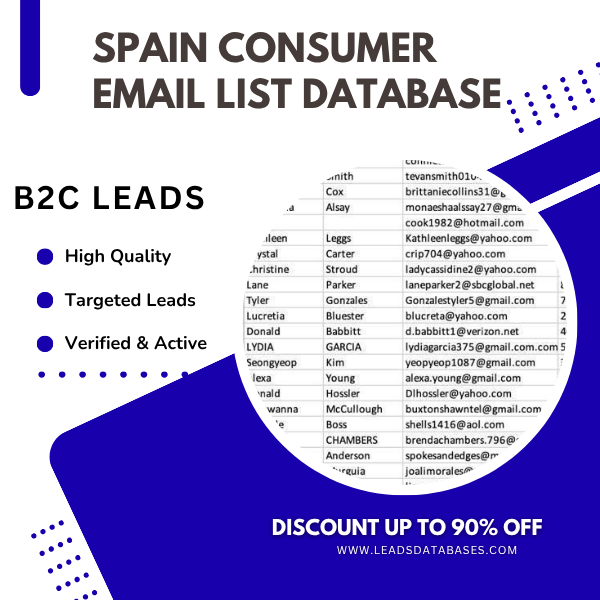
Leads Name: Spain Consumer Email List Database
Accuracy Rate: 95%+ Verified, Less Than 3% Bounce
Coverage: All Spain States & Cities
Data Fields: Full Name, Email, Phone Number & More
Format: Delivered in Clean Excel (.xlsx), No Duplicates
Special Feature: Fresh & Ready-to-Use Data That Converts
Spain Consumer Email List: What It Is, How Consumer Data Is Used, and Best Practices for Responsible Email Marketing
A Spain Consumer Email List refers to a consumer marketing database that may include email addresses and other contact information collected and maintained for legitimate business purposes. Businesses may use consumer data to support customer relationship management (CRM), market research, audience segmentation, and permission-based email marketing while complying with applicable privacy laws, including the European Union’s GDPR and Spain’s data protection framework.
A high-quality Spain consumer email database emphasises data accuracy, responsible data management, transparency, and privacy compliance rather than simply the number of contacts. Businesses that use customer information responsibly can improve customer engagement, personalise communications, and strengthen long-term relationships.
Why Businesses Search for Information About Spain Consumer Email Lists
Building meaningful customer relationships starts with understanding your audience. Businesses entering the Spanish market often look for ways to improve audience targeting, organise customer information, and deliver more relevant marketing communications.
Spain has a diverse consumer economy with major commercial centers such as Madrid, Barcelona, Valencia, Seville, Zaragoza, Málaga, and Bilbao. Companies operating in retail, eCommerce, tourism, financial services, education, technology, and consumer services frequently invest in customer data management, CRM systems, and digital marketing strategies to better understand consumer preferences.
A Spain consumer email list is often discussed alongside related concepts such as a Spain consumer email database, Spain consumer mailing list, consumer marketing database, consumer contact data, customer database, consumer data management, customer relationship management (CRM), marketing automation, audience segmentation, and email marketing. These terms describe different aspects of organising and managing customer information rather than guaranteeing marketing outcomes.
Successful marketing depends on several factors working together. Accurate customer records, valuable content, personalisation, responsible data practices, and ongoing campaign optimisation all contribute to stronger customer engagement. Businesses should also understand their responsibilities under privacy laws before collecting or using personal information for marketing purposes.
How Businesses Can Improve Customer Data Quality
Customer information changes over time. People update email addresses, change locations, modify communication preferences, or stop using certain accounts. Keeping customer records accurate is an ongoing process rather than a one-time task.
Businesses that invest in customer data management often benefit from more organised marketing operations and better reporting.
Review Customer Records Regularly
Regular data reviews help identify duplicate records, incomplete information, and outdated contact details. Maintaining a consistent database improves reporting and supports better decision-making across marketing, sales, and customer service teams.
Standardise Data Formats
Using consistent formats for names, locations, phone numbers, and email addresses makes information easier to search, organise, and analyse.
Standardised consumer contact data also simplifies integration with CRM platforms, customer support software, and business intelligence tools.
Integrate Customer Information
Many businesses collect customer information from multiple sources, including:
- Website contact forms
- Newsletter subscriptions
- Customer accounts
- Online purchases
- Customer support interactions
- Events and webinars
- Mobile applications
Bringing these sources together into one organised system creates a more complete view of customer relationships.
Common Uses of Consumer Marketing Data
Businesses across different industries use organised customer information for a variety of legitimate business purposes.
Retail and eCommerce
Retailers use customer insights to understand purchasing trends, improve customer experiences, and personalise product recommendations.
Travel and Hospitality
Travel companies, hotels, and tourism businesses often analyse customer preferences to improve service offerings and communicate relevant travel information.
Education
Educational institutions and online learning platforms use customer relationship management systems to organize prospective student inquiries, course information, and learner communications.
Financial Services
Banks, insurance providers, and financial service companies rely on accurate customer records to improve communication, customer support, and service management while complying with applicable regulatory requirements.
Technology Companies
Software providers frequently use CRM systems and marketing automation to manage customer onboarding, product updates, technical resources, and customer success programs.
Future Trends in Consumer Data Management
Customer data management continues to evolve alongside advances in technology and changing privacy expectations.
Several trends are shaping modern digital marketing:
First-Party Data Strategies
Businesses increasingly focus on information collected directly from their own customers through websites, customer accounts, subscriptions, and other direct interactions.
Marketing Automation
Automation platforms help businesses organise customer journeys, schedule communications, and monitor engagement while reducing repetitive manual work.
Artificial Intelligence
Artificial intelligence supports customer analytics, audience segmentation, predictive insights, and content personalisation. Human oversight remains important to ensure accuracy, fairness, and compliance.
Customer Experience
Organisations are placing greater emphasis on customer experience by creating more relevant interactions across email, websites, mobile applications, and customer support channels.
Conclusion
A Spain Consumer Email List is one part of the broader landscape of consumer marketing databases, customer relationship management (CRM), and digital marketing. Long-term success depends less on the size of a database and more on how effectively businesses manage customer information, maintain data quality, respect privacy, and deliver meaningful customer experiences.
Businesses should focus on maintaining accurate consumer contact data, improving audience segmentation, integrating information with CRM platforms, and following responsible data management practices. Combining organised customer information with valuable content, thoughtful personalisation, and ongoing performance analysis creates a stronger foundation for sustainable business growth.
As customer expectations and privacy requirements continue to evolve, organisations that prioritise transparency, data quality, and customer trust will be better positioned to build lasting relationships and improve marketing effectiveness.
Frequently Asked Questions
1. What is a Spain Consumer Email List?
A Spain Consumer Email List generally refers to a database that may contain consumer email addresses and related customer information collected and maintained for legitimate business purposes. Businesses use this type of Spain consumer email database for customer relationship management, market research, audience analysis, and permission-based communication, while complying with applicable privacy laws and responsible data management practices.
2. What is the difference between a Spain consumer email list and a consumer marketing database?
A Spain consumer email list typically refers to contact information used within broader customer management activities, while a consumer marketing database may include additional business information such as geographic data, customer preferences, interaction history, or segmentation attributes. The exact contents vary depending on how the information was collected, maintained, and organised.
3. Why is audience segmentation important?
Audience segmentation helps businesses organise customers into groups based on relevant characteristics such as location, interests, or customer lifecycle stage. Organised consumer contact data supports more relevant communication, improves customer experiences, and helps marketing teams better understand audience needs. Segmentation also makes reporting and campaign analysis more meaningful.
4. How does CRM improve customer data management?
Customer Relationship Management (CRM) software centralises customer information, helping businesses organise interactions, monitor customer relationships, improve customer service, and analyse marketing performance. Integrating a Spain customer database with CRM software can streamline workflows, support marketing automation, and provide better visibility into customer engagement across multiple business channels.
5. Why is data quality more important than database size?
An accurate, organised, and regularly maintained Spain consumer email database is generally more valuable than a much larger database containing outdated or duplicate records. High-quality consumer contact data supports better reporting, stronger customer relationships, more effective audience segmentation, improved CRM performance, and better decision-making throughout the customer lifecycle.