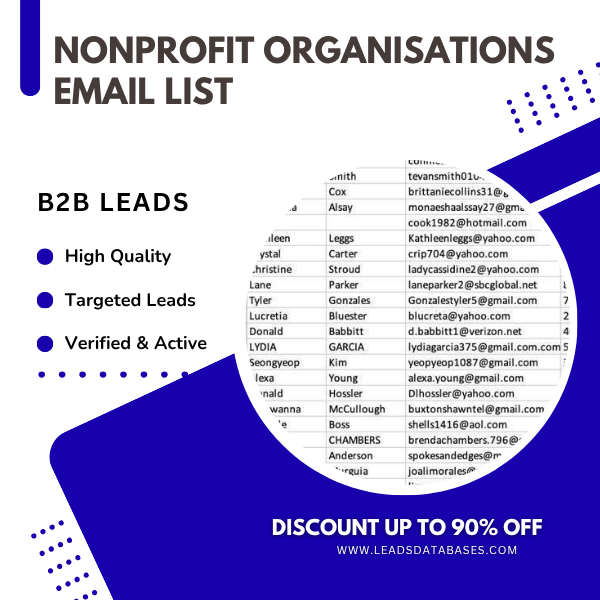
USA Nonprofit Organisations Email List Database
$490.00 Original price was: $490.00.$49.00Current price is: $49.00./0.00542402 0.00054240
Leads Name: USA Nonprofit Organisations Email List Database
Accuracy Rate: 95%+ Verified, Less Than 3% Bounce
Coverage: All USA States & Cities
Data Fields: Full Name, Email, Phone Number & Many More
Format: Delivered in Clean Excel (.xlsx), No Duplicates
Special Feature: Fresh & Ready-to-Use Data That Converts
Nonprofit Organisations Email List: Reach Verified Nonprofit Decision-Makers for Targeted B2B Marketing
Businesses that serve the nonprofit sector often face one common challenge: finding the right people to contact. Whether you offer fundraising software, accounting services, CRM platforms, cybersecurity, printing, consulting, payroll, or digital marketing, your success depends on reaching decision-makers who can evaluate your solution. Random prospecting wastes time, while outdated contact data leads to bounced emails and missed opportunities.
A Nonprofit Organisations email list helps businesses connect with charities, foundations, associations, educational institutions, religious organisations, humanitarian groups, and other nonprofit entities. Instead of spending weeks researching contacts manually, sales and marketing teams can focus on qualified prospects who are more likely to benefit from their products or services.
However, not every nonprofit email database offers the same level of quality. Accurate business information, relevant job titles, segmentation options, and regularly updated records all contribute to better outreach. A well-maintained nonprofit organisations mailing list also supports more personalised campaigns, improving engagement without relying on mass, un-targeted emails.
Why Choose Leadsdatabases.com
Finding business contacts is easy. Finding relevant, organised, and targeted business contacts is considerably harder. Leadsdatabases.com focuses on providing business email databases for companies looking to reach specific industries, including nonprofit organisations.
Rather than making broad marketing claims, the platform aims to provide searchable business contact data that supports sales prospecting and B2B marketing.
Industry-Focused Business Data
Instead of purchasing a generic business directory, buyers can explore databases focused on nonprofit organisations and other industries. Industry-specific targeting often results in more relevant outreach.
Detailed Contact Information
Depending on the available dataset, records may include:
- Organisation name
- Contact name
- Job title
- Business email address
- Phone number
- Website
- City
- State or province
- Country
- Postal code
- Industry classification
Available fields may vary by database.
Better Audience Segmentation
Different businesses serve different nonprofit organisations. Segmentation allows marketers to narrow their audience using filters such as:
- Geographic location
- Organization type
- Industry
- Job function
- Department
- Seniority level
This helps create more personalised campaigns instead of sending identical messages to every prospect.
Supports Multiple Outreach Strategies
Businesses may use a nonprofit email database for:
- Email marketing
- Lead generation
- Appointment setting
- Partnership development
- Webinar invitations
- Product launches
- Market research
- Business networking
Like any business contact database, outreach should comply with applicable email marketing and privacy regulations.
What Is a Nonprofit Organisations Email List?
A Nonprofit Organisations email list is a business contact database containing information about nonprofit organisations and, where available, the professionals responsible for purchasing decisions or organisational management.
These databases help companies identify organisations that match their target market while reducing manual research.
Types of Organisations Included
A nonprofit database may include contacts from:
- Charitable organisations
- Educational nonprofits
- Religious organisations
- Healthcare nonprofits
- Arts and cultural organisations
- Environmental organisations
- Animal welfare organisations
- Community development organisations
- Humanitarian organisations
- Professional associations
- Private foundations
- Public charities
The exact coverage depends on the provider and the selected database.
Decision-Makers You May Reach
Depending on the available records, contacts may include:
- Executive Directors
- Chief Executive Officers
- Development Directors
- Fundraising Managers
- Finance Directors
- Operations Managers
- Communications Directors
- IT Managers
- Program Directors
- Administrative leaders
Having role-specific contacts allows businesses to deliver messages that are relevant to each recipient’s responsibilities.
What Information Is Typically Included?
Business datasets commonly contain:
- Organisation name
- Business email address
- Contact person
- Job title
- Phone number
- Website
- Mailing address
- City
- State
- Country
- Postal code
- Industry category
Some databases may include additional business attributes depending on the source and available records.
Who Uses a Nonprofit Email Database?
Many industries provide products and services specifically designed for nonprofit organisations. A targeted contact database helps these businesses reach relevant organisations more efficiently.
Common users include:
- CRM software providers
- Donor management software companies
- Accounting firms
- Payroll providers
- Cybersecurity companies
- Cloud service providers
- Digital marketing agencies
- Printing and mailing companies
- Office equipment suppliers
- Grant management software vendors
- Event management platforms
- Business consultants
- HR solution providers
- Training organisations
- Fundraising technology companies
Instead of marketing to every business, these companies can focus on nonprofit organisations that are more likely to need their solutions.
Benefits of Using a Nonprofit Organisations Email List
A well-targeted Nonprofit Organisations email list helps businesses spend less time searching for prospects and more time building meaningful relationships. While success depends on your offer, messaging, and follow-up strategy, quality contact data creates a stronger foundation for every campaign.
Improve B2B Lead Generation
Finding nonprofit decision-makers manually can take hours. A verified nonprofit email database simplifies prospecting by providing organised business contact information in one place.
Sales teams can identify organisations that fit their ideal customer profile instead of relying on cold searches.
Reach Relevant Decision-Makers
Email campaigns perform better when they reach the right audience. A targeted nonprofit organisations mailing list helps businesses communicate with executives and department leaders who are more likely to evaluate new products or services.
Depending on the available records, this may include executive directors, development directors, fundraising managers, finance professionals, and operations leaders.
Save Time on Prospect Research
Researching organisations one website at a time can slow down marketing efforts. A business contact database reduces manual work by bringing together essential contact information in a structured format.
This allows sales representatives to focus on conversations rather than data collection.
Support Personalised Email Marketing
Modern email marketing is more effective when messages are relevant. Segmenting a nonprofit contact database by organisation type, location, or job title allows marketers to create campaigns that address specific needs.
For example, a donor management software provider may send different messaging to fundraising professionals than to finance teams.
Expand Into New Markets
Businesses planning to grow into new cities, states, or countries often need reliable prospect data. A segmented nonprofit database makes it easier to identify organisations in new geographic markets without starting research from scratch.
How to Choose the Right Nonprofit Organisations Email List
Not all business databases offer the same level of quality. Before purchasing a Nonprofit Organisations email list, evaluate several factors to ensure the data aligns with your marketing objectives.
Data Accuracy
Accurate business information helps reduce email bounces and improves campaign efficiency. Ask providers how frequently records are reviewed or updated.
No contact database remains perfect forever, so regular maintenance is an important consideration.
Relevant Job Titles
The best outreach reaches people who can influence purchasing decisions.
Look for databases that include leadership and departmental contacts such as:
- Executive Directors
- Development Directors
- Communications Managers
- Finance Directors
- IT Managers
- Operations Managers
Targeting the right role improves the relevance of your campaigns.
Geographic Coverage
Some businesses serve local nonprofit organisations, while others operate nationally or internationally.
Choose a nonprofit mailing database that matches your target markets, whether you’re focusing on one region or multiple countries.
Segmentation Options
Segmentation helps create more personalised marketing campaigns.
Useful filters may include:
- Country
- State or province
- City
- Organisation category
- Industry
- Job title
- Department
- Organisation size
The more relevant your audience, the more targeted your outreach can become.
Data Compliance
Businesses should always use contact information responsibly and comply with applicable privacy and commercial email regulations in the regions where they operate.
Responsible email marketing includes providing relevant content, identifying your business clearly, and honoring unsubscribe requests where required by law.
Best Practices for Marketing to Nonprofit Organisations
Buying a database is only the first step. Successful outreach depends on providing value and building trust with nonprofit professionals.
Understand the Nonprofit Sector
Nonprofit organisations often balance limited budgets, multiple priorities, and mission-driven goals. Marketing messages should focus on solving practical problems instead of making exaggerated promises.
Show how your product or service helps improve efficiency, reduce administrative work, increase fundraising capacity, or support organisational operations.
Personalise Every Campaign
Avoid sending identical emails to every contact.
Personalisation can include:
- Organisation name
- Recipient’s role
- Industry segment
- Geographic location
- Relevant use cases
Small details make outreach feel more relevant and less like mass marketing.
Keep Emails Clear and Concise
Decision-makers receive many emails each day. Respect their time by getting to the point quickly.
A strong outreach email should explain:
- Who you are
- Why you’re reaching out
- How your solution helps
- What action you’d like the recipient to take
Clear communication often outperforms lengthy sales pitches.
Offer Helpful Resources
Educational content builds credibility before asking for a sale.
Useful resources may include:
- Industry guides
- White papers
- Case studies
- Product demonstrations
- Webinar invitations
- Best practice checklists
Helpful content positions your business as a knowledgeable partner rather than simply another vendor.
Measure Campaign Performance
Tracking campaign results helps improve future outreach.
Common email marketing metrics include:
- Delivery rate
- Open rate
- Click-through rate
- Reply rate
- Conversion rate
Regular analysis helps marketers refine subject lines, messaging, audience segmentation, and follow-up strategies over time.
Why Data Quality Matters More Than Database Size
A larger database isn’t always better. Thousands of irrelevant contacts are less valuable than a smaller list of organisations that closely match your target audience.
When evaluating a Nonprofit Organisations email list, consider the relevance of the contacts rather than focusing only on the number of records. Accurate business emails, appropriate job titles, and useful segmentation typically contribute more to campaign success than volume alone.
Businesses that prioritise quality over quantity often spend less time filtering data and more time engaging with qualified prospects. That’s why choosing a provider that emphasizes organised business contact information can support more efficient lead generation and long-term relationship building.
Conclusion
A Nonprofit Organisations email list can help businesses connect with charities, foundations, associations, and other mission-driven organisations more efficiently. Instead of investing significant time in manual prospecting, sales and marketing teams can use targeted business contact data to identify relevant organisations and build personalised outreach campaigns.
The value of any nonprofit email database depends on more than the number of records it contains. Accurate contact information, relevant decision-makers, practical segmentation, and responsible data management all contribute to more effective B2B marketing. Whether your goal is lead generation, partnership development, webinar promotion, or introducing a new software solution, quality data provides a stronger starting point.
Leadsdatabases.com offers business contact databases across multiple industries, including the nonprofit sector. Before selecting any database, review the available fields, geographic coverage, and segmentation options to ensure they align with your marketing objectives. A well-targeted database, combined with valuable content and thoughtful outreach, can help your business build meaningful relationships with nonprofit organisations.
Frequently Asked Questions
What is a Nonprofit Organisations email list?
A Nonprofit Organisations email list is a business contact database containing information about nonprofit organisations and, where available, key decision-makers. Typical records may include organisation names, business email addresses, contact names, job titles, phone numbers, websites, and location details. Businesses use these databases to support B2B prospecting, email marketing, appointment setting, partnership outreach, and lead generation while reducing the time spent researching contacts manually.
Who can benefit from a nonprofit email database?
A wide range of businesses market products and services to nonprofit organisations. Common users include CRM providers, donor management software companies, accounting firms, cybersecurity providers, HR solution vendors, digital marketing agencies, consulting firms, payroll companies, office equipment suppliers, event technology providers, and fundraising software companies. A targeted nonprofit contact database helps these organisations reach relevant prospects more efficiently.
What information is usually included in a nonprofit organisations mailing list?
The contents vary by provider, but a nonprofit organisations mailing list commonly includes organisation names, contact names, business email addresses, phone numbers, websites, job titles, mailing addresses, cities, states, countries, postal type or department information, allowing businesses to segment prospects for more personalised marketing campaigns.
How should businesses use a Nonprofit Organisations email list?
Businesses should use a Nonprofit Organisations email list responsibly as part of a targeted outreach strategy. Instead of sending generic promotional emails, focus on providing relevant information that addresses the needs of nonprofit organisations. Personalise campaigns based on job roles, organisation types, or locations, and ensure your email marketing practices comply with applicable privacy and commercial email regulations in your target markets.
Why choose Leadsdatabases.com for nonprofit business contacts?
Leadsdatabases.com provides business contact databases for a variety of industries, including nonprofit organisations. The platform enables businesses to explore targeted contact data that may support lead generation, sales prospecting, and B2B marketing efforts. Before purchasing, buyers should review the available data fields, geographic coverage, and segmentation options to determine whether a specific nonprofit database aligns with their marketing goals and target audience.