USA Mental Health Care Email List Database
$1,350.00 Original price was: $1,350.00.$135.00Current price is: $135.00./0.01494373 0.00149437
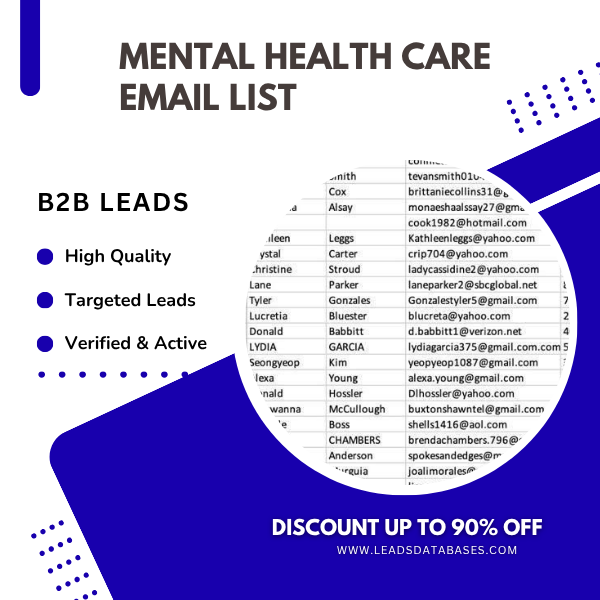
Leads Name: USA Mental Health Care Email List Database
Accuracy Rate: 95%+ Verified, Less Than 3% Bounce
Coverage: All USA States & Cities
Data Fields: Full Name, Email, Phone Number & Many More
Format: Delivered in Clean Excel (.xlsx), No Duplicates
Special Feature: Fresh & Ready-to-Use Data That Converts
Mental Health Care Email List: Connect with Mental Health Professionals Through Targeted B2B Marketing
Reaching mental health professionals isn’t as simple as sending thousands of marketing emails and hoping for replies. Therapists, psychologists, psychiatrists, behavioral health clinics, and counseling centers receive countless promotional messages every week. If your outreach isn’t relevant, personalized, and directed to the right people, it often ends up ignored.
That’s why many healthcare marketers, software providers, staffing agencies, insurance companies, and medical service providers rely on a Mental Health Care Email List to improve their outreach. A targeted business database allows you to connect with organizations and professionals who may actually need your products or services. Instead of spending hours researching contacts manually, your sales and marketing teams can focus on building meaningful business relationships.
Whether you’re promoting electronic health record (EHR) software, tele-health solutions, medical billing services, continuing education programs, recruitment services, cybersecurity tools, or healthcare consulting, having access to verified business contacts can make your campaigns more efficient. The key is using accurate, well-organised data alongside valuable email content rather than relying on generic mass marketing.
A quality Mental Health Care Email List can include contacts from behavioral health providers, mental health clinics, psychiatric hospitals, counseling centers, addiction treatment facilities, rehabilitation centers, community mental health organizations, and private practices. When combined with thoughtful email marketing and proper audience segmentation, it becomes a valuable resource for healthcare lead generation, appointment setting, event promotion, and long-term B2B relationship building.
Unlike broad healthcare databases, a targeted behavioral health email database helps businesses reach professionals working specifically in mental healthcare. This focused approach supports better personalization, stronger engagement, and more relevant conversations with decision-makers. Whether your goal is to generate qualified healthcare leads, promote industry events, or introduce innovative healthcare solutions, starting with the right contact database gives your campaigns a stronger foundation.
Why Choose Leadsdatabases.com
Finding a large healthcare database is relatively easy. Finding one that supports targeted B2B marketing is much more important. Leadsdatabases.com provides industry-specific contact databases designed to help businesses reach relevant professionals across healthcare and many other sectors.
Rather than positioning itself as a universally “best” provider, Leadsdatabases.com focuses on delivering organized business contact data that businesses can use for sales prospecting, healthcare marketing, and lead generation.
Industry-Specific Healthcare Contacts
Healthcare is a broad industry with countless specialties. Marketing to every healthcare organization at once often leads to poor campaign performance.
A Mental Health Care Email List allows businesses to focus on professionals working within behavioral healthcare, including:
- Mental health clinics
- Behavioral health providers
- Psychiatric hospitals
- Counseling centers
- Private therapy practices
- Community mental health centers
- Addiction treatment centers
- Substance abuse recovery facilities
- Rehabilitation centers
- Telepsychiatry providers
- Mental wellness organizations
- Outpatient behavioral health clinics
This level of targeting helps marketers create more relevant campaigns instead of sending generic healthcare promotions.
Reach Qualified Decision-Makers
Many B2B companies want to communicate with professionals who influence purchasing decisions rather than general staff members.
Depending on the available records, a healthcare contact database may include professionals such as:
- Psychiatrists
- Clinical psychologists
- Licensed therapists
- Licensed professional counselors
- Behavioral therapists
- Social workers
- Practice managers
- Clinic administrators
- Medical directors
- Behavioral health executives
- Healthcare administrators
- Office managers
Targeting the right decision-makers can help improve the efficiency of sales outreach while reducing time spent searching for contacts manually.
Comprehensive Business Contact Information
Businesses often need more than an email address.
Depending on the available data, records may include:
- Organization name
- Contact name
- Professional email address
- Business phone number
- Job title
- Practice address
- City
- State
- ZIP code
- Website
- Industry classification
Having multiple data fields allows marketing teams to segment audiences more effectively and personalize campaigns based on location, organization type, or professional role.
Designed for Better Audience Segmentation
One of the biggest mistakes in email marketing is treating every prospect exactly the same.
Healthcare organizations differ in size, services, specialties, and operational needs. A behavioral health clinic may have different priorities than a psychiatric hospital or an addiction recovery center.
Leadsdatabases.com supports more focused marketing by allowing businesses to segment contacts using criteria such as:
- Geographic location
- Healthcare specialty
- Organization type
- Professional role
- Practice size
- Service category
Better segmentation often leads to more relevant messaging and stronger engagement.
Supports Multiple B2B Industries
A Mental Health Care Email List isn’t only useful for healthcare companies.
Businesses that commonly market to behavioral healthcare organizations include:
- Healthcare software companies
- Electronic health record (EHR) providers
- Telehealth technology companies
- Medical billing companies
- Healthcare staffing agencies
- Continuing education providers
- Medical equipment suppliers
- Insurance companies
- Financial service providers
- Healthcare consulting firms
- Digital marketing agencies
- Medical publishing companies
Each of these industries can benefit from connecting with mental health professionals through targeted B2B outreach rather than broad, untargeted campaigns.
Built for Modern Healthcare Marketing
Today’s email marketing is no longer about sending thousands of identical messages.
Successful campaigns often combine:
- Personalized email marketing
- Healthcare lead generation
- CRM integration
- Account-based marketing (ABM)
- Educational content
- Webinar invitations
- Product demonstrations
- Industry newsletters
- Event promotion
- Relationship nurturing
A targeted Mental Health Care Email List provides the contact foundation that supports these marketing strategies.
Instead of guessing who might be interested, businesses can focus their efforts on reaching organizations that align with their products and services.
How a Mental Health Care Email List Improves Healthcare Lead Generation
Every successful marketing campaign starts with reaching the right audience. In the healthcare industry, that audience is rarely “everyone.” Mental health organisations have unique operational needs, purchasing processes, and compliance requirements. A targeted Mental Health Care Email List helps businesses connect with professionals who are more likely to have an interest in specialized products and services.
Rather than relying on cold outreach to random healthcare facilities, marketers can focus on behavioural health providers, mental health clinics, counselling practices, psychiatric hospitals, and other organisations that align with their ideal customer profile.
Generate More Qualified Healthcare Leads
Lead generation isn’t just about collecting contact information. It’s about identifying businesses that match your target market.
A targeted mental health professionals email list helps companies reach organizations such as:
- Behavioral health clinics
- Community mental health centers
- Private counseling practices
- Psychiatric hospitals
- Addiction recovery centers
- Residential treatment facilities
- Outpatient behavioral health programs
- Mental wellness organizations
- Crisis intervention centers
- Rehabilitation facilities
When your audience is more relevant, your outreach has a stronger chance of starting meaningful business conversations.
Connect with Healthcare Decision-Makers
Many healthcare purchases involve several stakeholders. Depending on your product or service, you may need to communicate with professionals responsible for clinical operations, administration, finance, or technology.
A well-organized healthcare contact database may help you identify professionals such as:
- Practice owners
- Clinic directors
- Medical directors
- Behavioral health administrators
- Practice managers
- Office managers
- Purchasing managers
- Operations directors
- Clinical supervisors
- Healthcare executives
Reaching decision-makers directly can reduce delays and help your sales team focus on qualified opportunities instead of spending hours searching for the right contact.
Support Personalized Email Marketing
Personalization has become one of the most important factors in B2B email marketing.
Healthcare professionals respond better to messages that address their specific challenges instead of generic promotional emails.
For example:
- A psychiatrist email list may be suitable for promoting electronic prescribing software.
- A psychologist email list may be more relevant for assessment tools, continuing education, or patient engagement platforms.
- A licensed therapist email list can support campaigns for teletherapy software, scheduling systems, documentation tools, or secure video consultation platforms.
The more relevant your message, the more valuable it becomes to the recipient.
Improve Sales Prospecting
Building prospect lists manually takes time.
Sales representatives often spend hours researching websites, verifying contact information, and identifying decision-makers before they can even send the first email.
Using a healthcare prospect list allows teams to spend more time on activities that directly support revenue, including:
- Product demonstrations
- Discovery meetings
- Proposal development
- Follow-up communication
- Account management
- Relationship building
That shift in focus can improve productivity across the entire sales process.
Strengthen Account-Based Marketing (ABM)
Many healthcare vendors now use Account-Based Marketing (ABM) instead of broad email blasts.
Rather than targeting thousands of unrelated organisations, ABM focuses on carefully selected accounts that fit your ideal customer profile.
A targeted behavioral health email database supports this strategy by helping businesses identify organisations based on factors such as:
- Practice type
- Location
- Organization size
- Healthcare specialty
- Professional role
Marketing and sales teams can then create customised campaigns for each account, increasing relevance and improving engagement.
Who Can Benefit from a Mental Health Care Email List?
A Mental Health Care Email List supports far more industries than people often expect. While healthcare organisations are the primary audience, many B2B companies provide products and services specifically designed for behavioral health professionals.
Healthcare Software Companies
Technology continues to reshape mental healthcare.
Software providers often market solutions such as:
- Electronic Health Record (EHR) systems
- Practice management software
- Appointment scheduling platforms
- Telehealth software
- Telepsychiatry solutions
- Patient communication tools
- Secure messaging platforms
- Revenue cycle management software
- Medical billing systems
- Healthcare CRM platforms
- Cybersecurity solutions
A targeted behavioral healthcare providers mailing list allows software vendors to reach organizations that may benefit from digital transformation.
Medical Billing and Revenue Cycle Companies
Behavioral health organizations frequently outsource billing or invest in revenue cycle management solutions.
Companies offering:
- Insurance claim processing
- Coding support
- Revenue cycle consulting
- Medical billing software
- Payment processing
can use a mental health clinics mailing list to promote services to practices that handle complex reimbursement processes.
Healthcare Staffing and Recruitment Agencies
Many mental health organizations actively recruit qualified professionals.
Recruitment firms often market to:
- Psychiatric hospitals
- Counseling centers
- Community clinics
- Behavioral health organizations
- Residential treatment programs
using targeted databases to introduce staffing solutions for psychiatrists, psychologists, counselors, nurses, social workers, and administrative personnel.
Continuing Education Providers
Mental health professionals regularly participate in continuing education to maintain professional licenses and expand their clinical knowledge.
Training organisations may promote:
- Accredited CE courses
- Clinical workshops
- Certification programs
- Professional conferences
- Online learning platforms
- Mental health webinars
A licensed counselor email list or clinical psychologist mailing list allows education providers to reach professionals who value ongoing learning.
Healthcare Consulting Firms
Consultants serving behavioral health organizations often specialize in areas such as:
- Regulatory compliance
- Practice growth
- Workflow improvement
- Strategic planning
- Technology implementation
- Revenue optimization
- Accreditation preparation
A targeted healthcare executives mailing list helps consulting firms introduce specialised services to organizations that may need operational support.
Insurance and Financial Service Providers
Mental healthcare organisations also require business services beyond clinical care.
Companies offering:
- Professional liability insurance
- Business insurance
- Payroll services
- Accounting support
- Tax consulting
- Retirement planning
- Commercial financing
can use a medical practice email list to reach practice owners and administrators responsible for financial decisions.
Healthcare Marketing Agencies
Marketing agencies specialising in healthcare often provide:
- Healthcare SEO
- Website development
- Content marketing
- Reputation management
- Social media marketing
- PPC advertising
- Email marketing
- Patient acquisition strategies
A Mental Health Care Email List helps agencies introduce these services to clinics seeking sustainable business growth and stronger patient engagement.
Key Features to Look for in a Mental Health Care Email List
Not all business databases are structured the same way. Before purchasing a healthcare mailing list, it’s worth evaluating the information provided and how it aligns with your marketing goals.
Look for databases that include, where available:
- Business name
- Contact name
- Professional email address
- Job title
- Business phone number
- Clinic address
- City and state
- ZIP code
- Website
- Practice type
- Healthcare specialty
Additional filtering options such as geographic region, organisation type, or professional role can make it easier to build targeted campaigns and personalise your outreach.
Just as important, use the data responsibly. Segment your audience, provide useful content, and follow applicable privacy and email marketing laws. A thoughtful approach helps build trust with mental health professionals and supports stronger long-term business relationships.
Best Practices for Using a Mental Health Care Email List
Purchasing a Mental Health Care Email List is only the first step. The real value comes from how you use the data. Successful healthcare marketing focuses on relevance, trust, and long-term relationships rather than sending large volumes of generic emails.
Below are practical strategies that can help you maximize your investment while maintaining a professional reputation.
Segment Your Audience Before Sending Campaigns
Mental healthcare is a diverse field. A private counseling practice has different needs than a psychiatric hospital or an addiction treatment center.
Instead of creating one email for everyone, divide your behavioral health contact list into meaningful segments based on factors such as:
- Practice type
- Professional specialty
- Geographic location
- Organization size
- Job title
- Healthcare services offered
Segmentation allows you to deliver more relevant content and create personalized email campaigns that speak directly to each audience.
Personalize Every Email
Healthcare professionals receive dozens of business emails every day. Generic subject lines and one-size-fits-all messaging often get ignored.
Simple personalization can make your outreach feel more relevant. Consider including:
- The recipient’s name
- Organization name
- Professional role
- Industry-specific challenges
- Relevant product benefits
For example, a message promoting telehealth software may resonate more with behavioral health clinics offering remote counseling than with organizations focused on residential treatment.
Provide Educational Value
The most effective healthcare email marketing campaigns focus on solving problems instead of making immediate sales.
Helpful content may include:
- Industry trends
- Mental healthcare technology updates
- Compliance resources
- Product demonstrations
- Case studies
- White papers
- Educational webinars
- Practice management tips
Providing valuable information positions your business as a knowledgeable partner rather than just another vendor.
Support Your Sales Team with Quality Data
A targeted B2B healthcare database helps sales teams identify organizations that fit their ideal customer profile. Instead of spending hours researching contacts, representatives can focus on:
- Prospect qualification
- Discovery calls
- Product presentations
- Follow-up conversations
- Relationship building
This approach improves efficiency and allows sales professionals to spend more time engaging with qualified prospects.
Combine Email with Multi-Channel Marketing
Email marketing works best when it supports a broader outreach strategy.
Businesses often combine a healthcare mailing list with:
- LinkedIn networking
- Educational webinars
- Content marketing
- Healthcare conferences
- Digital advertising
- Direct sales outreach
- CRM automation
A coordinated approach helps reinforce your message and keeps your brand visible throughout the buyer’s journey.
Respect Privacy and Compliance
Healthcare marketing requires careful attention to privacy and applicable laws. Businesses should follow regulations that apply to their recipients, such as GDPR, CAN-SPAM, or other relevant data protection and anti-spam requirements.
Good practices include:
- Sending relevant business communications
- Including a clear unsubscribe option
- Honoring opt-out requests promptly
- Maintaining accurate contact records
- Reviewing campaigns regularly for compliance
Responsible email marketing helps build trust while protecting your organization’s reputation.
Measure Campaign Performance
Every email campaign provides insights that can improve future outreach.
Track key performance indicators such as:
- Open rates
- Click-through rates
- Bounce rates
- Unsubscribe rates
- Reply rates
- Conversion rates
Reviewing these metrics helps identify which subject lines, offers, and content resonate most with mental health professionals.
Conclusion
Connecting with mental health professionals requires more than a large contact database. It requires relevant information, thoughtful communication, and a clear understanding of the healthcare industry.
A targeted Mental Health Care Email List helps businesses reach behavioral health providers, licensed therapists, psychologists, psychiatrists, counseling centers, community mental health organizations, addiction treatment facilities, and other healthcare professionals with greater precision. Instead of relying on broad, untargeted outreach, organizations can focus on building relationships with decision-makers who are more likely to benefit from their products or services.
Whether you provide healthcare software, medical billing solutions, staffing services, continuing education, insurance products, consulting, or digital marketing, a well-organized healthcare email database can support more efficient lead generation and sales prospecting.
Leadsdatabases.com offers industry-focused business contact databases designed to help companies reach relevant healthcare audiences. Combined with audience segmentation, personalised messaging, valuable content, and responsible email marketing practices, the right Mental Health Care Email List can become an important part of a long-term B2B marketing strategy.
Frequently Asked Questions
1. What is a Mental Health Care Email List?
A Mental Health Care Email List is a business contact database that contains information about organizations and professionals working in behavioral and mental healthcare. Depending on the available records, it may include business names, contact names, professional email addresses, job titles, phone numbers, practice locations, and websites. Businesses use these databases for B2B marketing, lead generation, webinar promotion, recruitment, healthcare technology outreach, and relationship-building with relevant professionals.
2. Who should use a Mental Health Care Email List?
Healthcare software companies, medical billing providers, healthcare staffing agencies, insurance companies, continuing education providers, consulting firms, pharmaceutical service providers, medical equipment suppliers, and healthcare marketing agencies commonly use a Mental Health Care Email List. A targeted database helps these organizations connect with therapists, psychologists, psychiatrists, behavioral health clinics, counseling centers, and healthcare administrators through more focused and relevant marketing campaigns.
3. What information is typically included in a Mental Health Care Email List?
The available information varies depending on the database and its source. Business records may include organization names, contact names, professional email addresses, business phone numbers, job titles, clinic addresses, city, state, ZIP code, website URLs, and industry classifications. Some healthcare contact databases also support filtering by specialty, geographic region, organization type, or professional role to help businesses create more targeted outreach campaigns.
4. How can businesses use a Mental Health Care Email List effectively?
The best results come from combining a quality Mental Health Care Email List with audience segmentation, personalized email content, educational resources, and consistent follow-up. Businesses should tailor messages to different healthcare specialties, provide useful information rather than only promotional content, and monitor campaign performance over time. Following applicable privacy regulations and honoring unsubscribe requests also helps maintain a positive sender reputation and stronger engagement.
5. Why is a targeted Mental Health Care Email List better than a general healthcare database?
A specialized Mental Health Care Email List focuses specifically on behavioral healthcare providers instead of covering the entire medical industry. This allows businesses to communicate with professionals whose organizations are more likely to have an interest in relevant products and services. Better audience targeting supports improved personalization, more meaningful conversations, efficient lead generation, and higher-quality B2B marketing opportunities compared with broad, untargeted healthcare mailing lists.