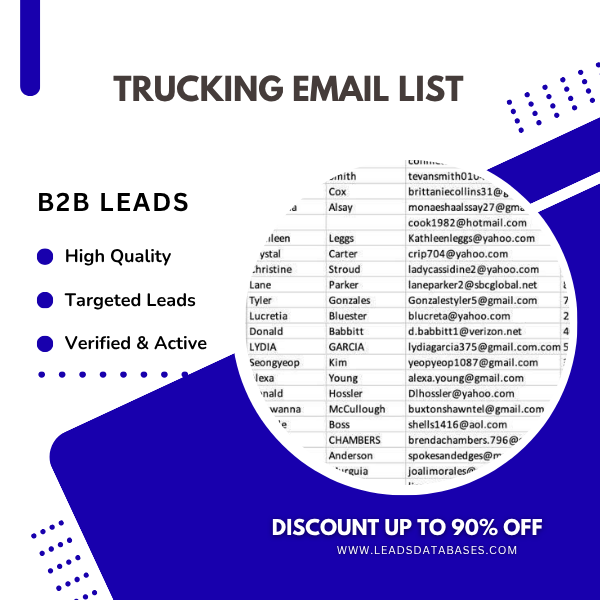
USA Trucking Email List Database
$999.00 Original price was: $999.00.$99.00Current price is: $99.00./0.01105836 0.00109587
Leads Name: USA Trucking Email List Database
Accuracy Rate: 95%+ Verified, Less Than 3% Bounce
Coverage: All USA States & Cities
Data Fields: Full Name, Email, Phone Number & Many More
Format: Delivered in Clean Excel (.xlsx), No Duplicates
Special Feature: Fresh & Ready-to-Use Data That Converts
Trucking Email List: Connect with Trucking Companies, Freight Carriers, and Logistics Decision-Makers
Finding qualified business prospects in the transportation industry can be challenging. Trucking companies receive calls, emails, and advertisements every day, making it difficult for vendors to reach the right decision-makers. Whether you sell fleet management software, commercial truck insurance, GPS tracking systems, fuel cards, transportation accounting software, safety solutions, payroll services, or maintenance products, connecting with businesses that genuinely need your services is essential.
A Trucking email list helps simplify B2B prospecting by providing access to business contacts within the trucking, freight transportation, logistics, and supply chain industries. Instead of marketing to a broad audience, companies can focus their outreach on transportation businesses that align with their ideal customer profile.
An effective trucking company email database is more than a collection of email addresses. High-quality business data may include company names, business email addresses, contact names, job titles, phone numbers, company locations, websites, fleet information where available, and industry classifications. These details allow sales and marketing teams to create personalised campaigns instead of relying on generic mass emails.
Businesses that use transportation contact databases often combine them with CRM platforms, email marketing software, and marketing automation tools to streamline lead generation and business development. When combined with relevant messaging and compliant email marketing practices, a trucking mailing list can support stronger prospecting efforts while helping sales teams spend more time speaking with qualified prospects.
Why Choose Leadsdatabases.com
Businesses purchasing a trucking company email list should look beyond the total number of contacts. Data quality, segmentation, relevance, and transparency have a greater impact on campaign performance than database size alone.
Leadsdatabases.com offers industry-focused business contact databases designed for companies that market products and services to transportation businesses. Rather than positioning itself as a universally “best” provider, the platform focuses on helping businesses identify relevant B2B prospects across multiple industries, including trucking and logistics.
Industry-Specific Business Contacts
Instead of purchasing a general business mailing list, companies can access contacts associated with:
- Trucking companies
- Freight carriers
- Transportation companies
- Logistics providers
- Third-party logistics (3PL) companies
- Fleet operators
- Distribution companies
- Freight forwarding businesses
- Commercial transportation companies
Industry-focused segmentation helps businesses create more relevant campaigns.
Reach Transportation Decision-Makers
Business purchasing decisions often involve several stakeholders. Depending on available records, a trucking email database may include contacts such as:
- Business owners
- Fleet managers
- Operations managers
- Transportation directors
- Logistics managers
- Dispatch managers
- Purchasing managers
- Safety managers
- Procurement professionals
Targeting the appropriate department allows marketers to send messages that address specific operational challenges.
Flexible Segmentation Options
Different transportation companies have different needs.
Businesses may filter contacts by:
- Country
- State
- City
- Industry category
- Company size
- Employee count
- Job function
- Revenue range (where available)
Segmentation supports more personalized email marketing and lead generation campaigns.
Supports Multiple Marketing Objectives
A trucking email list can be used for:
- B2B email marketing
- Sales prospecting
- Appointment setting
- Product launches
- Webinar invitations
- Fleet software demonstrations
- Commercial service promotions
- Partnership outreach
- Customer acquisition campaigns
Because transportation businesses purchase a wide range of products and services, targeted outreach remains an important part of many B2B marketing strategies.
Compatible with Modern Sales Workflows
Many organisations integrate transportation business contacts into CRM systems and marketing automation platforms to manage outreach, nurture prospects, and monitor campaign performance over time.
Using organised business data can make prospecting more efficient while reducing time spent researching individual companies.
What Is a Trucking Email List?
A Trucking email list is a business contact database that contains information about companies operating in the trucking, freight transportation, logistics, and supply chain sectors. Businesses use these lists to identify potential customers, build sales pipelines, and support B2B marketing campaigns.
Depending on the provider, a trucking company email database may include:
- Company name
- Business email address
- Contact name
- Job title
- Phone number (when available)
- Company website
- Business location
- Industry classification
- Employee size or company size (where available)
Unlike consumer mailing lists, a trucking mailing list is intended for business-to-business (B2B) communication. Companies selling products or services to transportation businesses use these databases to reach relevant decision-makers more efficiently.
What Types of Companies Are Included?
A transportation business database may include contacts from organisations such as:
- Trucking companies
- Freight carriers
- Regional and long-haul transportation companies
- Logistics companies
- Third-party logistics (3PL) providers
- Freight forwarding companies
- Fleet management businesses
- Last-mile delivery companies
- Refrigerated transportation providers
- Flatbed trucking companies
- Heavy haul transportation companies
- Intermodal transportation companies
- Warehousing and distribution businesses
The exact industries and data fields vary by provider, so reviewing the available information before purchasing is important.
Who Uses a Trucking Email List?
Many businesses market products and services to the transportation industry. A targeted trucking company contact database helps these organisations reach prospective customers more efficiently.
Common buyers include:
Fleet Management Software Providers
Companies offering fleet management platforms, telematics, vehicle tracking, maintenance scheduling, and reporting software often market directly to fleet owners and transportation managers.
GPS Tracking and Telematics Companies
Businesses selling GPS tracking devices, electronic logging device (ELD) solutions, dash cameras, and route optimisation software frequently target trucking companies that operate commercial vehicle fleets.
Commercial Insurance Agencies
Insurance providers offering commercial truck insurance, cargo insurance, fleet insurance, workers’ compensation, and business liability coverage use transportation email databases to identify potential commercial clients.
Truck Equipment and Parts Suppliers
Manufacturers and distributors of truck accessories, trailers, replacement parts, tires, fuel systems, lighting equipment, and safety products often promote their solutions to trucking businesses.
Financial Service Providers
Invoice factoring companies, commercial lenders, leasing companies, equipment financing providers, and fuel card companies frequently work with transportation businesses that require flexible financing options.
Driver Recruitment Companies
Recruitment agencies, CDL training providers, staffing firms, and workforce management companies often market their services to trucking businesses looking to hire qualified commercial drivers.
Business Technology Providers
Companies offering payroll software, accounting systems, cybersecurity solutions, CRM software, document management, and cloud services also benefit from reaching transportation decision-makers.
Benefits of Using a Trucking Email List
A well-maintained trucking email list supports more targeted B2B marketing and can improve the efficiency of prospecting efforts.
Reach the Right Audience
Instead of marketing to businesses across every industry, companies can focus on transportation organisations that are more likely to need their products or services.
Targeted outreach helps sales teams spend more time engaging qualified prospects.
Improve Lead Generation
Finding new business opportunities often begins with identifying companies that match your ideal customer profile.
A trucking company database provides a starting point for building prospect lists and expanding your sales pipeline.
Support Personalised Email Marketing
Segmentation allows businesses to create campaigns based on factors such as company size, location, or job role.
For example:
- Fleet managers may be interested in vehicle maintenance software.
- Operations managers may focus on route optimisation.
- Safety managers may evaluate compliance and driver safety solutions.
Personalised messaging generally creates a better experience than sending identical emails to every contact.
Save Time on Research
Manually searching for transportation businesses can take hours.
An organised business contact database reduces research time, allowing marketing and sales teams to focus on outreach, relationship building, and follow-up.
Integrate with Existing Sales Tools
Many organisations import business contacts into CRM platforms, sales engagement software, and marketing automation tools to manage campaigns more efficiently.
Integration also helps teams track conversations, schedule follow-ups, and measure campaign performance.
Industries That Market to Trucking Companies
The trucking industry depends on a wide range of business services and operational technologies. As a result, many industries regularly market to transportation companies.
Common examples include:
Fleet Technology
- Fleet management software
- Transportation Management Systems (TMS)
- Electronic Logging Device (ELD) solutions
- GPS fleet tracking
- Dispatch software
- Vehicle diagnostics platforms
Transportation Safety
- Driver safety training
- Compliance consulting
- Drug and alcohol testing services
- Dash camera solutions
- Risk management software
Vehicle Maintenance
- Preventive maintenance providers
- Commercial truck repair services
- Tire suppliers
- Engine component manufacturers
- Trailer maintenance companies
- Parts distributors
Business Services
Transportation companies also purchase:
- Payroll software
- HR services
- Accounting solutions
- Tax consulting
- Legal services
- Commercial banking products
- Business insurance
- Fuel management solutions
Understanding these related industries helps marketers create more relevant campaigns for transportation businesses.
Key Features to Look for in a Trucking Email Database
Not every trucking business database offers the same level of quality. Before purchasing, evaluate several important factors.
Accurate Business Information
Look for providers that regularly review and maintain their business data. Current contact information helps reduce bounced emails and improves the efficiency of outreach campaigns.
Relevant Industry Coverage
A transportation-focused database should primarily include businesses involved in trucking, freight transportation, logistics, fleet operations, warehousing, and related commercial services.
Segmentation Options
Effective segmentation may include:
- Geographic location
- Company size
- Employee count
- Industry type
- Job title
- Department
- Business category
Targeted lists often produce more relevant outreach than broad, unfiltered databases.
CRM Compatibility
Businesses frequently import contact data into CRM systems to manage sales activities and customer relationships.
Common file formats such as CSV or Excel simplify integration with many marketing and sales platforms.
Transparent Data Practices
A reputable provider should clearly explain what information is included, how records are organized, and how the data is maintained. Transparency helps buyers understand the scope of the database before making a purchase.
Best Practices for Using a Trucking Email List
Purchasing a trucking email list is only the first step. Successful B2B email marketing depends on relevant messaging, audience segmentation, and consistent follow-up. Businesses that focus on solving customer problems instead of simply promoting products are more likely to build meaningful relationships.
Segment Your Audience Before Sending Emails
Not every transportation company has the same priorities. A small regional carrier may be looking for affordable fleet maintenance solutions, while a national logistics provider may be interested in transportation management software or route optimisation tools.
Consider segmenting your trucking contact database by:
- Company size
- Fleet size (where available)
- Geographic region
- Industry segment
- Job title
- Business function
Sending relevant content to each audience helps improve engagement and creates a better experience for recipients.
Write Emails That Solve Real Business Problems
Transportation businesses face operational challenges every day. Instead of leading with a sales pitch, focus on explaining how your product or service addresses a specific need.
Common challenges include:
- Rising fuel costs
- Fleet maintenance planning
- Driver recruitment and retention
- Vehicle safety
- Route optimization
- Regulatory compliance
- Equipment financing
- Dispatch efficiency
- Customer communication
- Cost control
Educational content often performs better than promotional copy because it demonstrates practical value.
Personalise Your Outreach
Simple personalisation can make emails more relevant.
Include details such as:
- Company name
- Contact name
- Job role
- Industry-specific messaging
- Local market references when appropriate
Personalisation does not need to be complicated. Even small details can help your message feel more relevant to the recipient.
Build Long-Term Relationships
Email marketing should support relationship building rather than one-time sales.
Useful follow-up content may include:
- Industry guides
- Product demonstrations
- Case studies
- Educational webinars
- Maintenance checklists
- Fleet management resources
- Transportation compliance updates
- Product comparison guides
Consistent communication helps keep your business visible throughout the buyer’s decision-making process.
Email Marketing Compliance for Transportation Businesses
A trucking email list should always be used responsibly. Businesses should understand the email marketing regulations that apply to the regions where they operate.
For example:
- The CAN-SPAM Act establishes rules for commercial email in the United States.
- The General Data Protection Regulation (GDPR) applies to the processing of personal data in relevant situations involving individuals in the European Economic Area.
- Other countries may have their own commercial email and privacy regulations.
Following applicable laws typically includes:
- Clearly identifying commercial emails
- Providing accurate sender information
- Including a straightforward unsubscribe option where required
- Honoring opt-out requests promptly
- Maintaining appropriate records and consent practices when applicable
Compliance supports both legal obligations and long-term customer trust.
Common Mistakes to Avoid When Buying a Trucking Email List
Choosing the right trucking company database requires more than comparing prices. Avoiding common mistakes can help improve campaign performance and reduce wasted marketing effort.
Buying Based Only on List Size
A large database is not automatically more valuable. Thousands of unrelated contacts are often less useful than a smaller, well-targeted list that closely matches your ideal customer profile.
Ignoring Data Quality
Business information changes over time. Employees change roles, companies relocate, and email addresses become inactive. Choosing a provider that maintains and updates business data can improve campaign efficiency.
Sending Generic Email Campaigns
Mass emails with identical messaging rarely address the different needs of fleet managers, logistics directors, business owners, or operations teams.
Tailoring content to specific audiences creates more relevant communication.
Skipping Follow-Up
Many B2B purchases involve research, internal discussions, and multiple decision-makers. A thoughtful follow-up strategy can help maintain engagement without overwhelming prospective customers.
Focusing Only on Selling
Educational content often builds stronger relationships than constant promotional messaging.
Sharing helpful resources demonstrates industry knowledge while positioning your business as a trusted partner.
Why Data Quality Matters in a Trucking Email Database
The effectiveness of any B2B marketing campaign depends heavily on the quality of the underlying business data.
A reliable trucking email database should prioritise:
- Relevant industry coverage
- Organised business records
- Current company information
- Useful segmentation options
- Clear documentation of available data fields
High-quality data supports more accurate prospecting, improves marketing efficiency, and helps sales teams focus on businesses that align with their products or services.
Rather than measuring success by the number of contacts alone, businesses should evaluate how well the database supports their specific marketing goals.
Conclusion
A Trucking email list can be a valuable resource for businesses that market products and services to trucking companies, freight carriers, logistics providers, fleet operators, and other transportation organisations. Whether your goal is lead generation, sales prospecting, account-based marketing, or customer acquisition, access to relevant business contacts can help make outreach more focused and efficient.
The best results come from combining accurate business data with thoughtful segmentation, personalised messaging, and consistent follow-up. Instead of relying on broad marketing campaigns, businesses can tailor their communications to the needs of fleet managers, logistics professionals, transportation executives, and other decision-makers.
Leadsdatabases.com provides industry-specific business contact databases designed to support B2B marketing, email outreach, and business development. By focusing on relevant transportation industry contacts and practical segmentation options, businesses can build more targeted campaigns while integrating contact data into their existing CRM and marketing workflows.
Frequently Asked Questions
1. What is a Trucking email list?
A Trucking email list is a business database containing contact information for trucking companies, freight carriers, logistics providers, transportation businesses, and fleet operators. Depending on the provider, records may include company names, business email addresses, contact names, job titles, phone numbers, websites, and locations. Businesses commonly use these databases for B2B email marketing, lead generation, sales prospecting, and promoting products or services to transportation industry decision-makers.
2. Who should use a trucking company email database?
A trucking company email database is useful for businesses that sell products or services to the transportation sector. Examples include fleet management software providers, commercial insurance agencies, GPS tracking companies, truck equipment manufacturers, payroll software vendors, recruiting firms, compliance consultants, accounting providers, fuel card companies, and commercial financing organisations. These businesses use targeted contact data to improve prospecting and connect with relevant decision-makers.
3. What information is typically included in a trucking email list?
The information included varies by provider but often consists of company names, business email addresses, contact names, job titles, phone numbers, websites, company locations, and industry classifications. Some databases also provide company size, employee count, or other business attributes where available. Reviewing the available data fields before purchasing helps ensure the database supports your marketing and sales objectives.
4. How can businesses get better results from a trucking email list?
Better results come from combining quality business data with effective marketing practices. Segment your audience, personalise your emails, focus on solving customer problems, provide useful educational content, and maintain consistent follow-up. Businesses should also comply with applicable email marketing regulations and regularly update their CRM to keep contact information organised and current. A thoughtful strategy generally performs better than sending large volumes of generic emails.
5. Why choose Leadsdatabases.com for trucking business contacts?
Leadsdatabases.com provides industry-focused business contact databases for organisations conducting B2B marketing and sales outreach. Its trucking database is designed to help businesses identify transportation companies, freight carriers, logistics providers, and other relevant organisations. Rather than relying on broad business directories, companies can use targeted contact data to support lead generation, business development, customer acquisition, and long-term relationship building within the transportation industry.